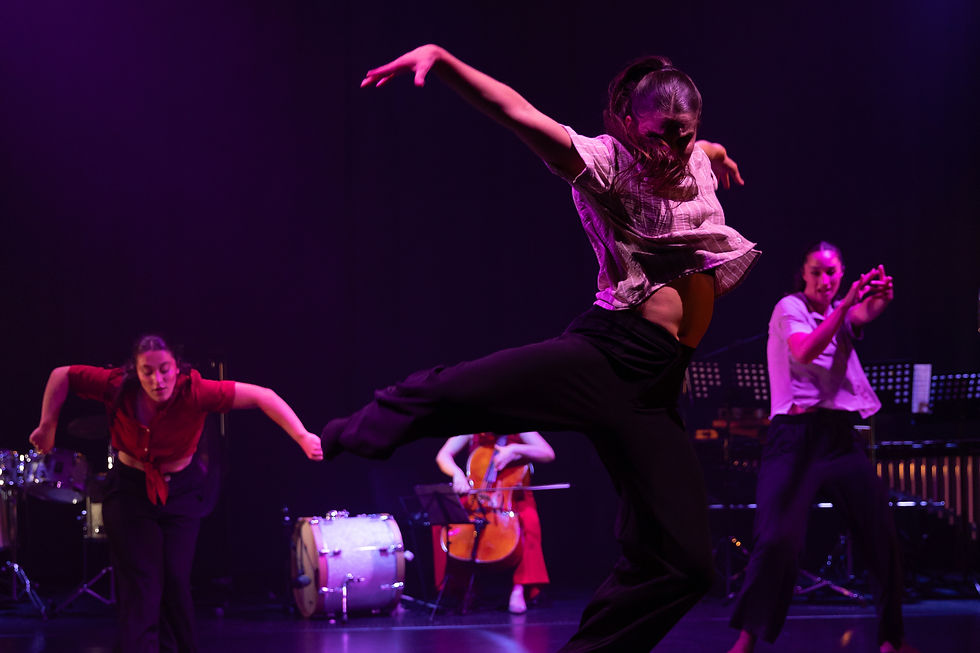
Photo by Stephen Buhagiar
The seventh edition of MAD (Music & Dance) presents a dance residency connecting international artists with local talent. Choreographers Alessio Damiani from Italy and Jade Farrugia from Malta have been commissioned to work with a selected group of local and international dancers to create three new choreographies. The music selected for the choreographic works is the string quartet John's Book of Alleged Dances by John Adams. The ten short movements mix driving rhythmic energy with sly humour, off‑kilter grooves and moments of lyrical introspection. Several movements are played against pre‑recorded rhythmic tracks, creating the feeling of a live quartet “plugged into” an imaginary band, while others stand alone in more intimate, chamber‑like textures. The programme also presents two masterworks from the 20th century string quartet repertoire: Black Angels by George Crumb and Penderecki’s String Quartet No.1
Programme
George Crumb Black Angels (1970)
Thirteen Images from the Dark Land
for amplified string quartet
I. Departure (Fall from Grace)
Threnody I: Night of the Electric Insects; Sounds of
Bones and Flutes; Lost Bells; Devil-music; Danse Macabre
II. Absence (Spiritual Annihilation)
Pavana Lachrymae (Der Tod und das Mädchen);
Threnody II: Black Angels!; Sarabanda de la Muerte
Oscura; Lost Bells (Echo)
III. Return (Redemption)
God-music; Ancient Voices; Ancient Voices (Echo);
Threnody III: Night of the Electric Insects
John Adams John's Book of Alleged Dances (1994)
I Judah to Ocean
II Toot Nipple
III Dogjam
IV Pavane: She's So Fine
Marko Nikodijevic Tiefenrausch - String Quartet No. 1 (2016)
John Adams John's Book of Alleged Dances (1994)
V Rag the Bone
VI Habanera
VII Stubble Crotchet
VIII Hammer & Chisel
Krzysztof Penderecki String Quartet No. 1 (1960)
John Adams John's Book of Alleged Dances (1994)
IX Alligator Escalator
X Ständchen: The Little Serenade
XI Judah to Ocean (reprise)
Credits
HearAndNow Collective Emma Roijackers - violin
Joseph Puglia - violin
Constance Pharoah - viola
Sebastiaan Joseph van Halsema - cello
Choreographers: Alessio Damiani
Jade Farrugia Dancers: Antea Buro Lea Bitri
Matilda Molendi
Nina Ragonesi
Victoria Mercieca Programme Notes
Black Angels (1970) - George Crumb
Composed during the Vietnam War, George Crumb’s Black Angels: Thirteen Images from the Dark Land radically expands the conventions of the string quartet, turning the ensemble into a theatre of sound. Written for amplified instruments, the piece magnifies every gesture: bow hair scratches, tapping on wood, whispered glissandi and eerie sul ponticello all become central musical material rather than special effects. The players whistle, shout numbers in different languages and retune their strings, constantly destabilising any sense of normal sonority. Crumb asks the musicians to play with thimbles on the strings, to produce bell‑like harmonics and to bow on unconventional parts of the instrument, creating ghostly clusters and insect‑like textures. Percussive instruments and crystal glasses further erode the boundary between string quartet and sound installation. In Black Angels, extended technique is not an ornament but the main expressive language, embodying the work’s themes of war, alienation and a precarious search for transcendence.
John's Book of Alleged Dances (1994) - John Adams
John Adams wrote John’s Book of Alleged Dances in 1994 for the Kronos Quartet, imagining a set of “dances” that may or may not actually be danceable. The ten short movements mix driving rhythmic energy with sly humour, off‑kilter grooves and moments of lyrical introspection. Several movements are played against pre‑recorded rhythmic tracks, creating the feeling of a live quartet “plugged into” an imaginary band, while others stand alone in more intimate, chamber‑like textures. Adams draws freely on swing, hoedown fiddling, minimalist repetition and baroque figuration, often twisting these references with unexpected accents and metric jolts. The title’s “alleged” hints at the music’s playful ambiguity: sometimes the beat is irresistibly clear, at other times it slips out of reach, like a memory of dancing rather than the dance itself. The result is a witty, highly physical work that invites the listener to hear the string quartet as a quirky, postmodern dance machine.
Tiefenrausch – String Quartet No. 1 (2016) - Marko Nikodijević
Tiefenrausch – String Quartet No. 1 plunges the listener into an immersive sonic “deep dive,” as the title suggests. The work draws on densely layered textures, shifting pulses and gradual transformations of harmony to create a sense of submersion in sound. Rather than foregrounding traditional melody, Nikodijević favours evolving sound-masses: whispered harmonics, scratch tones and muted figures that coalesce into surges of energy before dissolving again. The quartet often functions as a single, breathing organism with closely intertwined lines and micro-variations of intonation and colour. Dynamic extremes and sudden changes of density heighten the feeling of pressure and release, like waves or deep currents. Tiefenrausch thus becomes less a narrative and more an experience of altered perception, inviting the audience to listen inside the sound, resonance and afterglow—rather than simply following themes or motifs.
String Quartet No. 1 (1960) - Krzysztof Penderecki
This quartet belongs to Penderecki’s early avant‑garde period, when he was radically rethinking instrumental sound. Cast in a single continuous movement, the work abandons traditional melody and harmony in favour of colour, texture and gesture. The four instruments are treated almost as sound laboratories, exploring glissandi, clustered dissonances, extreme registers and a wide range of unconventional bowing techniques. Instead of thematic development, the music unfolds through blocks of contrasting sonorities and sharply profiled events, creating an intense, sometimes unsettling atmosphere. Moments of near‑silence and fragile, pointillistic writing sit alongside dense, noisy eruptions, heightening the sense of tension and unpredictability. In this quartet, Penderecki extends the expressive possibilities of the string ensemble, offering a vivid snapshot of the post‑war European avant‑garde and laying foundations for the distinctive personal voice he would continue to refine in later decades.
Biographies
HearAndNow Collective

The HearAndNow Collective comprises 13 young musicians from the Netherlands, the United States, the United Kingdom, Portugal, Germany, France and Italy. Formed during the inaugural HearAndNow Chamber Music Festival in Amsterdam, the ensemble shares the festival’s mission to broaden access to contemporary music and support emerging composers. Despite its recent founding, the collective has quickly built a strong reputation in the Netherlands and abroad, receiving invitations from leading international contemporary music festivals such as the Presteigne Festival in Wales and collaborating with composers from around the world. Recent highlights include a tour to Australia, featuring collaborations with Hollis Taylor and Jon Rose, a concert tour across the Netherlands and several recording projects. The ensemble performs in a variety of instrumental combinations, but appears most frequently as a string quartet.
Alessio Damiani - choreographer

Born in Palermo in 1993, Alessio Damiani began his dance training in his hometown, later joining the young company Agora Coaching Project under Michele Merola and Enrico Morelli at 18. He has worked as a freelance dancer and teacher in Italy and Germany and since March 2017 has been a member of the Hessisches Staatsballett at the Staatstheater Wiesbaden. He has collaborated with leading international choreographers including Ohad Naharin, Sharon Eyal, Imre and Marne van Opstal, Damien Jalet, Eyal Dadon, Nadav Zelner, Edward Clug, among others. In recent years he has also developed his career as a choreographer. His work Burdens of Being has toured widely and been a finalist in major competitions such as Barnes Crossing, the International Competition in Hannover, Burgos & New York and Prospettiva Danza in Padova, and featured at festivals including Quinzena de Dança de Almada, TanzBiennale Heidelberg and the Festival de Danse de Cannes. His recent creation for Companhia de Dança de Almada, Echoes of Your Loss, premiered on 12 October.
Jade Farrugia - choreographer
With a passion for movement and expression, Jade has honed her craft through extensive training in classical ballet, contemporary, and modern theatre at The Dance Workshop, Malta. She has had the privilege of collaborating with esteemed choreographers and dance companies, including MavinKhooDance, Moveo Dance Company, DanceWorks, and PK Projects, as well as performing at cultural events like the Dubai Expo 2020 and M.A.D. dance residency 2022. Jade has also had the opportunity to choreograph pieces for Moveo Junior Company, Young Creatives in Motion and Festivals Malta. Jade also shares her expertise by teaching contemporary and classical ballet at The Dance Workshop. Jade holds a Masters in Structural Engineering and is also currently reading towards a Masters in Dance Science at the University of Bern.