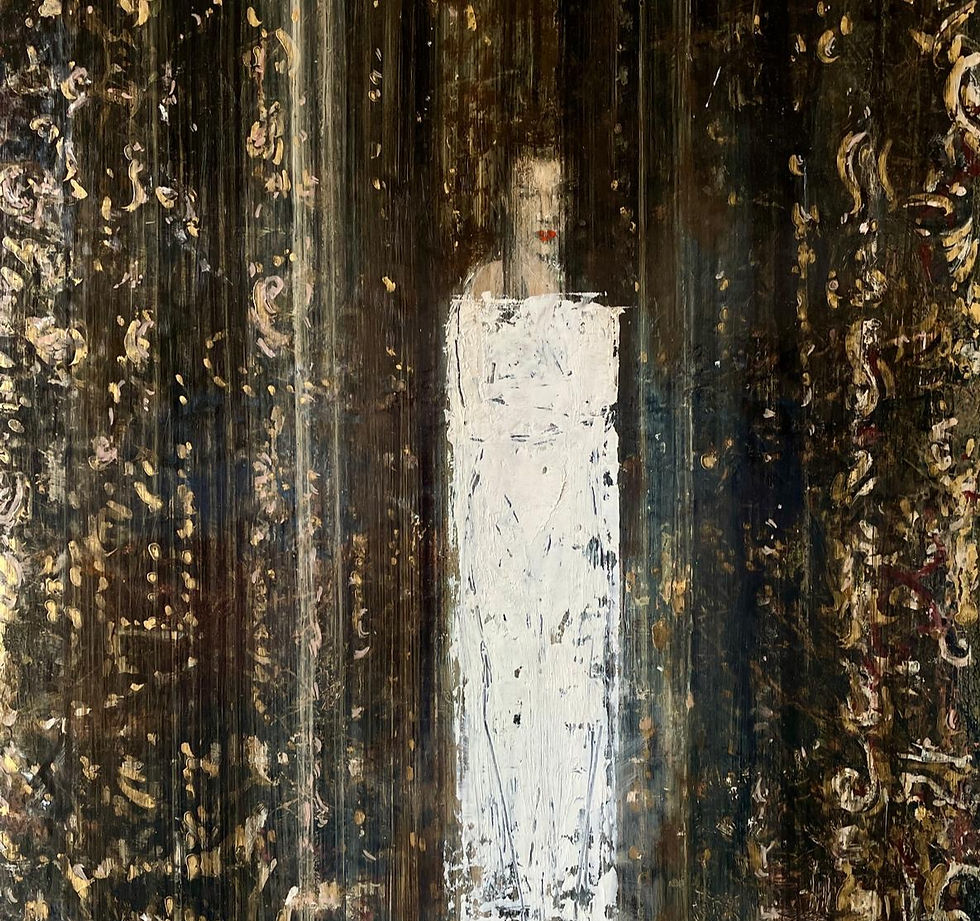
James Gemmill, Woman in White, 32cm x 43cm, oil on canvas. Artists:
Luke Azzopardi, couturier
Michelle Castelletti, curator
Giuseppe Inglese, violoncello
Simon Riccardi-Zani, dancer
Maria Theuma, story weaver and narrator
James Gemmill, artist
Jimmy Bartolo, sound artist
SWORD, artefact from The Grandmaster’s Palace collection
Beneath the ceremonial splendour of Valletta’s Grand Master’s Palace lies another world. The former Palace stables once housed the horses and carriages that sustained the theatre of state above: movement, labour, and physical power contained within massive stone walls.
For one evening, this hidden architecture becomes ‘Soft Weapons’ – an immersive encounter with Medea through haute couture, music, movement, spoken word, light, scent, touch, and taste. Sumptuous, daring, and touched with decadence, it begins with a contradiction: what if softness could be a weapon?
Medea – woman, outsider, lover, mother, sorceress, and agent of terrible revenge – is one of antiquity’s most troubling figures. Rather than simply returning to the archetype of the murderous woman, Soft Weapons asks why female power, sexuality, rage, and violence have so often been represented as dangerous.
At the physical centre of this world stands a historic weapon from the Palace Armoury: hard, static, untouchable, preserved behind glass. Around it, everything moves.
Fabric flows around the body. It conceals and reveals, restricts and liberates, protects and seduces. Through couture, it becomes skin and armour, vulnerability and threat. A dancer animates it as the material becomes his partner; a narrator gives voice to a story told and retold for more than two millennia. The permanence of the historic object encounters the sensuality and transience of the living body.
Yet, steel and cloth are not such unlikely companions. The world of the Grand Masters was rich in uniforms, robes, banners, vestments, carpets and tapestries: weapon and textile belonged to the same language of ceremony, identity, and power. Here, high fashion does not illustrate history: it parleys with it – it seduces it, challenges it, and, occasionally, misbehaves with it.
And another woman inhabits the space.
Caught within a solitary spotlight, a small painting by James Gemmill emerges from the darkness: a mysterious woman in white, glimpsed behind a veil or fall of fabric. Present, yet withheld, she becomes a silent counterpoint to the dancer and to Medea herself. Is the fabric concealing her or protecting her? Is she imprisoned by it, or choosing to remain beyond our reach? White suggests purity, ceremony, perhaps sacrifice; a flash of red at her lips hints at sensuality, defiance, and danger. She offers no answer. She simply watches.
Music moves through these encounters. Impressions of Cherubini’s Médée evoke Medea’s psychological landscape. Delicacy confronts monumentality; grace need not signify fragility, nor softness, weakness. At the musical centre is the solo cello, a live human voice without words, capable of tenderness, seduction, and violence.
Bach’s Suite for Solo Cello No. 5 in C Minor, BWV 1011, enters this world almost as another act of transformation. Written in scordatura, with the cello’s highest string lowered from A to G, the work physically alters the instrument’s tension and darkens its resonance: the familiar body of the cello is made subtly strange. In the extraordinary Sarabande, Bach strips the instrument still further. There are no chords, no double stops – only a single, exposed melodic line. Solitary and unadorned, it acquires an almost unbearable intensity. Here, too, softness is not the opposite of power. And perhaps this solitary voice finds an echo in Gemmill’s woman in white: suspended, withheld, present but unreachable. Like Medea herself, she occupies a space at once within and outside the world around her. The cello does not explain her, nor does she illustrate the music. For a moment, they simply inhabit the same solitude – one caught forever in paint, the other disappearing even as it sounds.
Around the live cello, a soundscape unsettles the acoustic world: fragments of voice and music, the resonance of metal, scissors through cloth, stitching, tearing, fabric drawn across stone. Sound, like fabric, moves through and activates the architecture.
The other senses are drawn into the ritual. Fabric invites touch; scent inhabits the air. A chalice of red wine brings taste, pleasure, and indulgence – but also blood, passion, communion, and sacrifice. To lift the chalice and drink is to cross a subtle threshold from spectator to participant. There is decadence here, but decadence with an edge: beauty is never entirely separated from danger.
Nothing remains fixed. Narration becomes music; music becomes movement; movement dissolves into stillness. Fabric brushes flesh. Wine enters the body. The dancer flows while the sword remains immovable. Gemmill’s painted woman is forever suspended. Live sound disappears at the moment of its creation, while the historic object endures.
At the heart of ‘Soft Weapons’ is the creative dialogue between couturier Luke Azzopardi and interdisciplinary curator Michelle Castelletti. Their minds feed, challenge, and provoke one another. Ideas collide, seduce, unravel and reform; the creative process remains deliberately free, allowing the work to morph and change until it becomes what it needs – and wants – to be. When they work together, the unexpected happens – or perhaps, by now, the unexpected is precisely what should be expected.
The Old Stables become not a backdrop, but a participant: stone, history and memory drawn into an encounter between the beautiful and the dangerous, the sensual and the violent, the preserved and the ephemeral.
Stone and fabric.
Blade and body.
Chalice and blood.
Voice and silence.
Movement and staticity.
Decadence and danger.
And somewhere between them lies the question: where does power reside?
In the sword?
In the hand that might wield it?
In the fabric enveloping a body?
In the voice telling the story?
Or in the gaze that decides what should be desired—and what should be feared?
The sword remains still.
The fabric moves.
The wine is consumed.
The body passes.
The music disappears.
The woman watches.
And the story remains.
Luke Azzopardi and Michelle Castelletti
Following the event, there will be a silent auction for James Gemmill, Woman in White, 32cm x 43cm, oil on canvas.
THE VENUE
Standing at the heart of Valletta on St George’s Square, the Grand Master’s Palace has been a centre of authority in Malta for 450 years. Its origins lie in the earliest years of the new city: the complex developed during the 1570s around existing buildings, and was subsequently enlarged and transformed into the official residence and administrative centre of the Grand Masters of the Order of St John.
Architecturally, the Palace grew rather than emerging from a single fixed design. Behind its comparatively restrained limestone façades lies a complex world of courtyards, ceremonial halls, private apartments, corridors, service spaces and gardens. Successive Grand Masters altered and embellished the building, transforming its Renaissance origins into a palace capable of expressing the ceremonial power of the Order.
On the Piano Nobile, the Throne Room, Ambassadors’ Room and Grand Master’s apartments created a theatre of diplomacy, ceremony and display. Elaborate eighteenth-century illusionistic ceiling paintings enriched its corridors, while Matteo Perez d’Aleccio’s remarkable cycle depicting the Great Siege of 1565 embedded the Order’s own history into the fabric of the Palace.
Yet behind this spectacle was another architecture entirely. The Palace was an enormous working household, and its grandeur depended upon an intricate machinery of service and movement. Nowhere is this more evocative than in the former Palace stables at ground level. Here were horses and carriages, grooms and attendants; the sounds of hooves and harnesses; the rhythms of preparation, movement, arrival and departure. Dignitaries might ascend into the ceremonial world above, but beneath them horses were tended, transport prepared and the practical business of palace life continued. The robust architecture of the stables offers a striking counterpoint to the richly decorated State Rooms: upstairs was representation; downstairs, the physical machinery that made representation possible. The stables later acquired another identity when, for decades, they housed the Palace Armoury, before the collection was returned to its historic seventeenth-century hall on the Piano Nobile as part of the Palace’s recent restoration.
The Palace itself continued to evolve alongside Malta’s political history. During the British period it became the Governor’s Palace; in 1921 it housed Malta’s first constitutional Parliament; and today it remains the seat of the Office of the President of Malta.
The Grand Master’s Palace can therefore be read in layers: ceremony and labour, splendour and utility, stillness and movement, the public performance of power and the unseen mechanisms that sustained it. Above and below, ceremonial and functional, the Palace was effectively a small state contained within a single architectural complex—an accumulation of spaces shaped and reshaped by nearly five centuries of Maltese history.